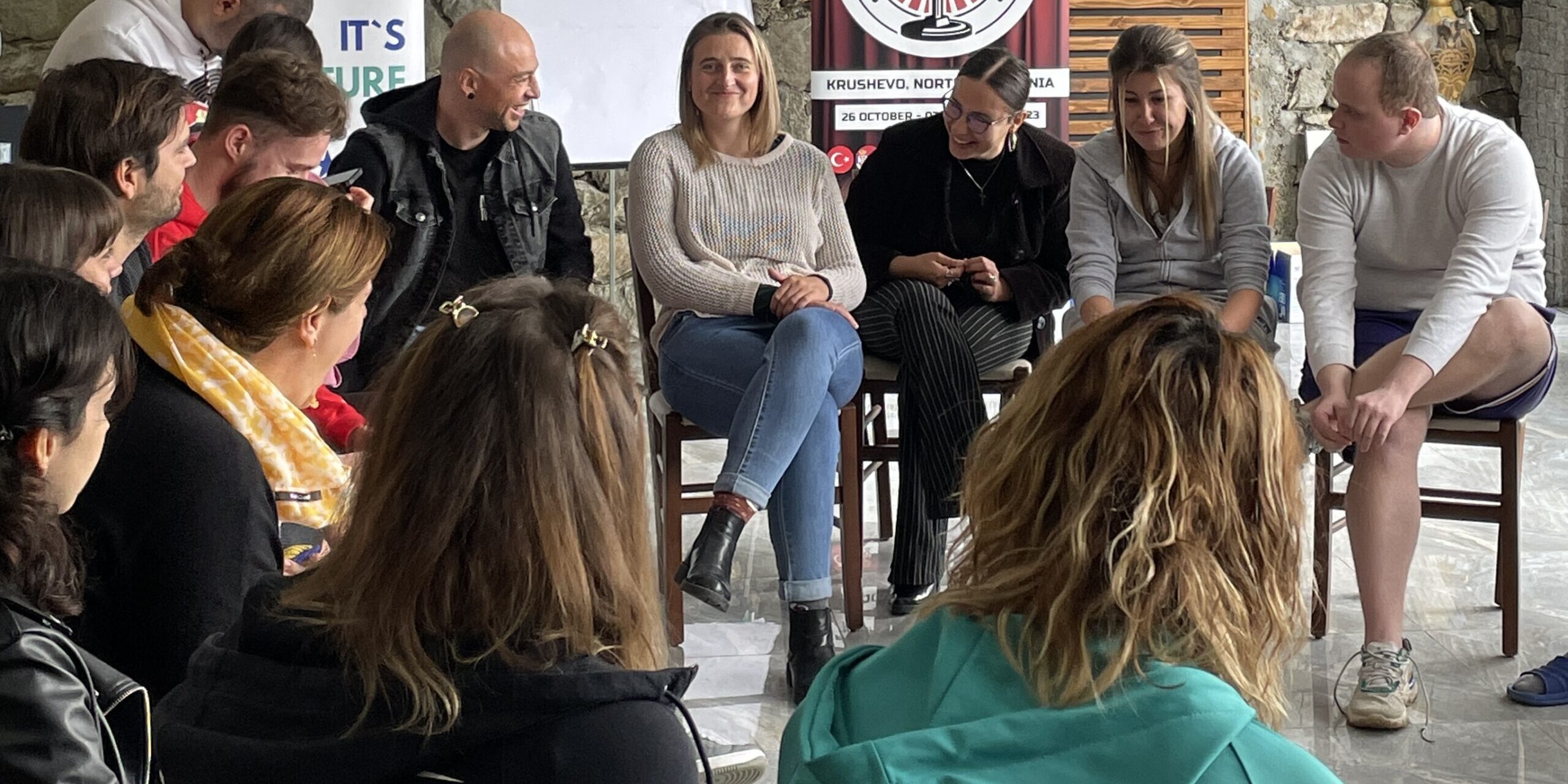
Youth work and non-formal education are the building blocks of social, cultural and educational improvement of youth outside the curriculum. Non-formal education in youth work enables young people to acquire essential competences that contribute to their personal and socio-educational development and foster their active participation in society, thereby improving their employment prospects.
Youth Work
Youth work is a broad term covering a wide variety of activities of a social, cultural, educational, environmental and/or political nature by, with and for young people, in groups or individually. Youth work is delivered by paid and volunteer youth workers and is based on non-formal and informal learning processes focused on young people and on voluntary participation. Youth work is quintessentially a social practice, working with young people and the societies in which they live, facilitating young people’s active participation and inclusion in their communities and in decision making (Council of Europe 2017).
For the European Union, youth work is: a broad term covering a large scope of activities of a social, cultural, educational or political nature both by, with and for young people. Increasingly, such activities also include sport and services for young people. Youth work belongs to the area of “out-of-school” education, as well as specific leisure time activities managed by professional or voluntary youth workers and youth leaders and is based on non-formal learning processes and on voluntary participation (EU Council Resolution 2009).
Youth work happens where young people are and on their terms. It is based on their voluntary participation and trust. Youth work can take place at any level, in any space or interactive environment, including virtually, or through direct contact. It can be one activity, or a regular programme of activities where young people interact with each other. In a youth work process, young people and youth workers grow together by, for example, challenging prejudice and individual, social and societal problems and by practising democracy. Youth work is based on non-formal education and learning processes, facilitated by youth workers, whereby young people learn to voice their aspirations – for themselves and for their communities – and work to bring about change. It is also a social practice, which often focuses on the social inclusion of young people, including those from disadvantaged backgrounds.
Youth work can be offered universally to all young people in youth clubs, cafes or in one-stop shops. It can also be targeted, through detached, street or mobile youth work, where it is aimed at supporting specific groups experiencing discrimination and multiple disadvantages. For example, targeted youth work may take place in remote rural areas, in disadvantaged neighbourhoods, juvenile prisons or in refugee camps.
Voluntary participation is one of the defining features of youth work. Another one is that it is non-judgmental. Youth workers and young people participate as equals – together they construct, develop and sustain their relationship. Youth work is a space for mutual support and encouragement, trust, learning opportunities, self-analysis and reflection, emotional development, social and cultural awareness and, ultimately, positive self-realisation.
Through their participation in youth work, young people should not only develop autonomy, assume responsibility for their actions and take charge of their life, but also become active citizens who question and challenge established norms with a view to bringing about positive social and political change. In practical terms, youth work is a journey undertaken with groups of young people who change and evolve; it can take place in a variety of locations, focus on a variety of issues and use different methods.
The perceived benefits of participation in youth work are many and varied and can include the creation of spaces for young people and “bridges” in their lives. The bridge-building role of youth work has a particularly strong impact on the lives of young people who are experiencing inequalities, disadvantages and discrimination.
Non-formal education
Non-formal education (NFE) refers to planned, structured programmes and processes of personal and social education for young people designed to improve a range of skills and competences, that happen outside the formal educational curriculum, including in youth organisations. NFE is complementary to formal and informal learning (adapted from Compass manual for Human Rights).
Non-formal education is important as it has a key role in providing opportunities for young people to acquire skills useful for their social inclusion, personal growth, and democratic engagement.
Key characteristics of NFE
Non-formal education may take different shapes and forms. There are some common characteristics, however:
- NFE is a planned learning process with educational objectives.
- NFE activities are based on the needs of learners. NFE activities are open to the input of learners to the learning process and encourage making links to real life.
- NFE is based on the voluntary participation of learners (in other words, NFE is not a compulsory activity).
- NFE is inclusive and accessible, in other words every young person can take part and organisers actively seek ways to include persons that may experience exclusion or marginalisation.
- NFE methodologies are varied, participatory and learner-centred, they include a mix of individual and group learning and encourage people to learn from each other.
- NFE it is all about learning life skills and preparing for active citizenship.
- NFE is holistic, which means engaging learners’ emotions, minds, and bodies.
- NFE activities may be run by professional educators/trainers and/or volunteers.
NFE is based on active participation (doing, experiencing). A central part of the learning process is self-reflection. Exercises in NFE are of an experiential nature (for example, simulations and role-plays) and input will always be interactive (a product of the facilitator and participants; they contribute with their experiences and knowledge).
Some tips to consider when developing NFE based activities within youth projects include:
- Make sure there is a logical link between the issues young people face, the educational process you propose and the impact of your activity for participants and wider communities. Think about what your activity will change in your context.
- Identify learning needs and learning outcomes for your participants.
- Match your objectives with the types of activities you propose, the time available, the needs of your participants, and the number of participants.
- Plan and structure your educational process, in a way that sessions link to each other and young people learn something meaningful in a step-by-step manner.
- Prepare your activity sessions, so that you know what you will be doing, how, and who from your project team is responsible.
- In the educational activities, provide enough time to explore and engage with relevant topics. Do not rush learning and do not try to discuss too many different topics in too short a time. Ensure time for reflection, and not just experiencing. Through reflection, participants will consolidate their learning.
- If participants are expected to deliver follow-up activities, dedicate time for them to plan and equip your participants with the adequate skills for their follow-up.
- If the activity includes the exploration of complex or sensitive issues, ensure sufficient time and appropriate methods for participants to engage with them.
- Active learning: avoid too many frontal presentations, as participants may disengage or get demotivated (or be reminded of their bad school days). Vary your methods and adapt your content to your participants! Don’t forget to consider participants’ emotions, minds, and bodies.
- Consider as much as possible accessibility needs, to ensure everyone’s participation in your activity. If your participants experience barriers that exclude them from taking part in your activity, actively seek ways to increase inclusion (for example, by removing participation fees, or by ensuring that all your participants can fully take part in each activity).
- The methods you use should allow participants to share and learn from their own experiences and the experiences of others in the group.
- If you are not sure you have within your organisation sufficient experience or expertise on the topic you wish to explore, search for a trainer or facilitator externally or cooperate with other entities.
- Ensure your project team includes a person responsible for the educational process and that most of the people in the team are young (under 30).
- Provide time for participants to get to know each other and to develop trust within your group of participants.
- Evaluate your activities. Adapt the evaluation method to your group of participants. Remember that in NFE, evaluation is done for your organisation to learn how to improve its activities and to have an indication of whether you reached the objectives set.